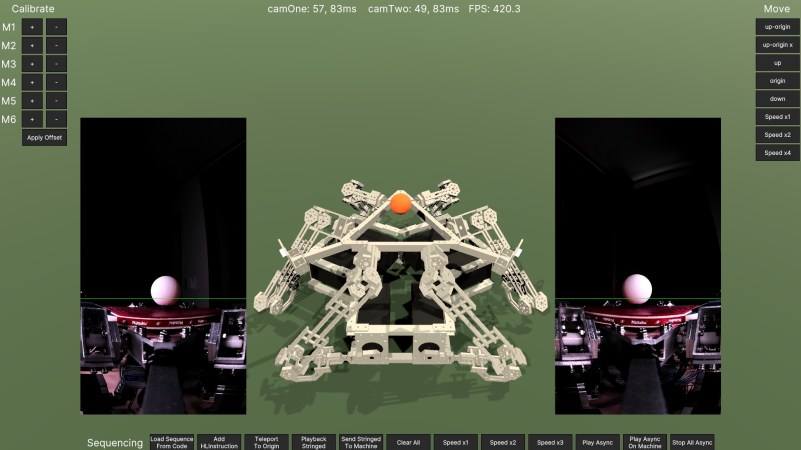
Sometimes, you want to build a simple project– the minimum viable product that solves your problem and nothing else. Other times you might be feeling a little extra, and want to use oodles of machined aluminum, six steppers, two cameras, a Teensy and a PC with a GPU just to bounce a ball. That’s the mood behind [T-Kuhn]’s hexa-bouncer, a Stewart Platform on steroids. You can read all about it on his blog or witness it in action in the video below. Trust us, really have to see it in action.
America’s mad scientists all have one dream: DARPA money. The Defense Advanced Research Projects Agency regularly throws round sweet, sweet tax dollars to push the envelope on any number of things, leading to such spin-offs as the very network carrying these words to you.
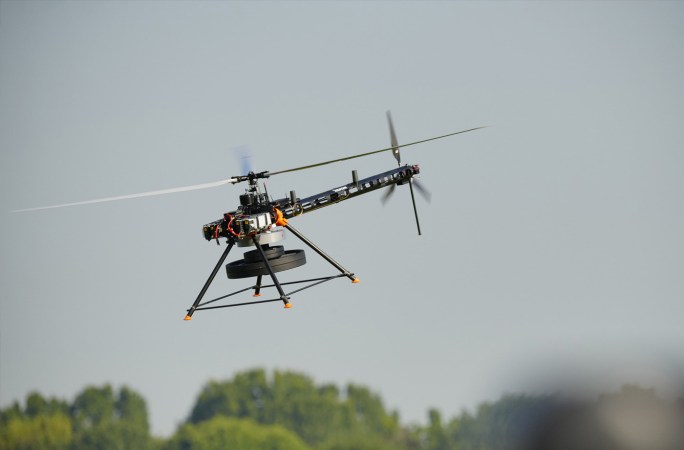
Not every DARPA project ends in revolution though — like the latest DARPA Lift Challenge, the goal of which was to see the creation of a vehicle that could perform Vertical Take Off And Landing with a payload four times its own weight. We’ve embedded the ‘look back’ video below.
We hoped for something revolutionary, something bizarre, something really, really cool — and there were absolutely entries on the field that met all of those superlatives. But sometimes conventional designs are the convention for a reason, and the winning entry developed by AVIDrone was just a very well made electric helicopter. One big lift rotor, one little tail rotor. Aside from clever details in the solid-state batteries and carbon-fiber construction, it’s a totally normal aircraft — albeit one that can lift 3.84X its dry weight, or 112 lb of payload. Interestingly a battery-powered hexrotor drone took home second place with a 3.64:1 lift ratio. Perhaps the big shock was not seeing combustion engines until third place: another helicopter, this time with a turbine engine. So much for energy density!
Some of the other more bizarre — if less performant — entries did get prizes to further their development, so we’ll likely see them back for the 2028 version of the challenge. Some of the concepts visible were covered here on Hackaday, like turning the drone body into a giant lift rotor, so perhaps one of you will have the bright idea that brings home a million in the next round of the contest.
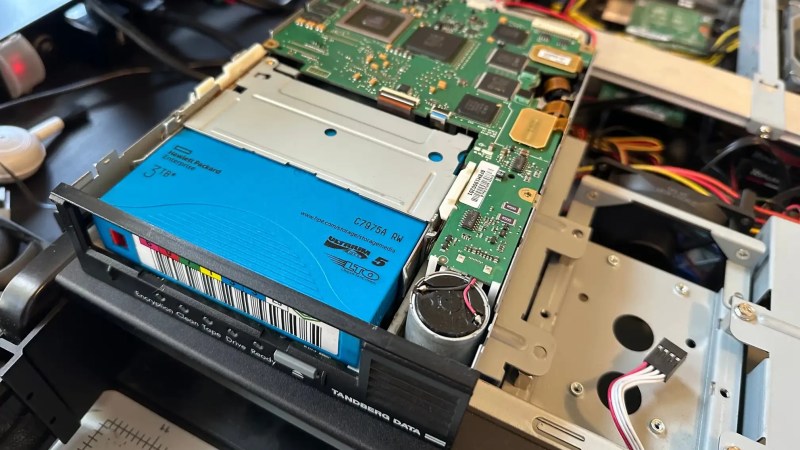
It’s one of the great mysteries of computing, how somehow in the Year Of OLlama 2026, tape remains the god of cheap storage. A while back [Ben Pettis] recounted his experience setting up an LTO-5 tape drive in his homelab, an experience which only becomes more relevant as hard drive prices stay high.
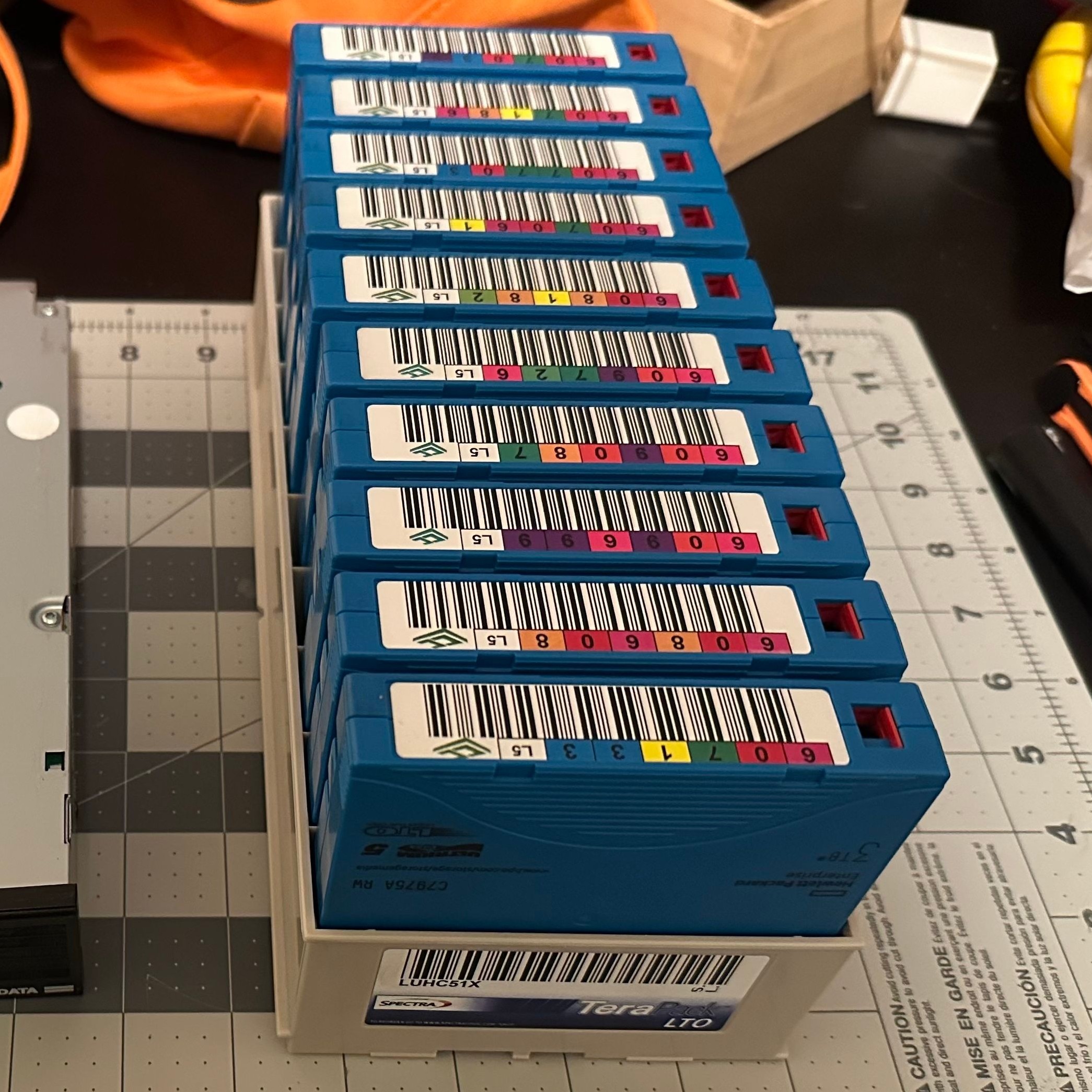
LTO-5 is already well out of date in the professional world, after all– a new server install would be debating the merits of LTO-9 versus LTO-10, but for the homelab it’s a matter of what’s affordable on the used market with decently-sized cartridges. If you can live with 1.5 TB of uncompressed data on a roughly palm-sized Linear Tape, Open cartridge then LTO-5 could be good enough. Yes, the tapes are advertized as 3TB, but that’s assuming a 2:1 compression ratio on the data, which you’re not likely to get on the photos and video that make up much of a data horder’s storage. That’s one thing [Ben] was quick to clear up for us. He also detailed his adventures with the cheaper-to-buy fiber channel model of drive.
The label would have you believe this box stores 30 TB.
Tape drives usually come with an SAS or fiber channel interface– fiber channel being, you guessed it, an optical solution unlike the SCSI-like SAS connection you may be familiar with for block storage devices. With a PCIe adapter it’s not hard to set up, provided you get the cables the right way around! That’s another detail we’re glad [Ben] shared so we can find it again if we have the same problem: with no switch in the circuit, you need a crossover cable to bring TX to RX. Which is obvious in retrospect, but obscure to those of us just learning about the standard.
The advantage, as [Ben] makes clear and everyone has always known is simply price. As of this writing, diskprices.com has 16$/TB as the lowest cost, while [Ben] was able to pick up lightly-used tapes on eBay for only 2$/TB. If you have a lot of data, those savings amortize the drive costs relatively quickly, since a used drive like [Ben]’s can be had for a few hundred bucks.
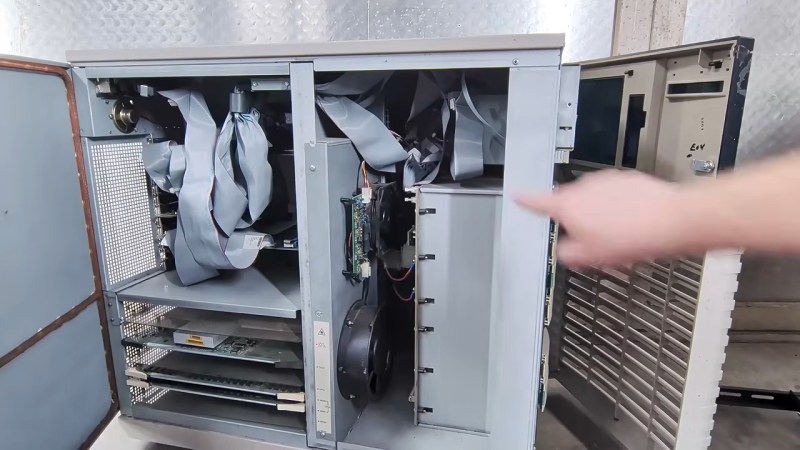
Retrocomputer enthusiasts have a bad rap as nerds who just want to play old video games. There’s some truth in this, but the reality is that we’re nerds who want to do all sorts of things with old hardware — everything from consoles to servers. Servers like the DEC AlphaServer 2100 [derelictelectronics] picked up at Vintage Computer Festival Midwest this year. He was kind enough to record a tour for those of us who missed seeing these early Alpha machines in their heyday.
DEC did sell these units with multiple-CPU reports from the get-go, but the [derelictronics] particular model has a single CPU board carrying a 64-bit Alpha RISC processor. This machine from 1994 dates to near the height of the RISC wars when it seemed everyone needed to have their own high-end architecture, all of them RISC. While the machine could host up to 2GB of RAM, the example [derelictelectronics] found only has 256 MB, which was still not a small number for 1994!
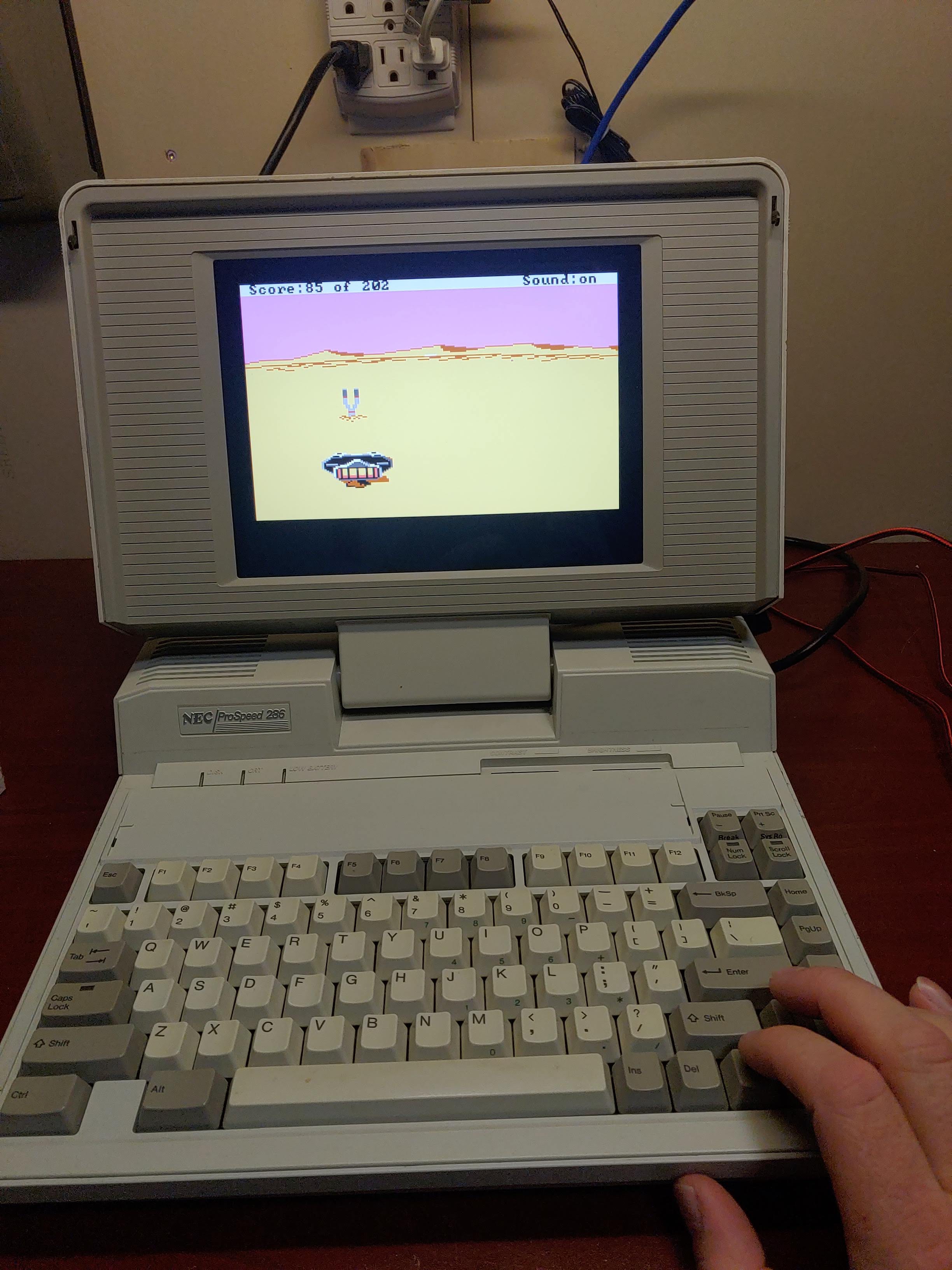
The sad reality is that all consumer electronics are going to be e-waste eventually. [Cory Whitesell] was determined his old NEC ProSpeed 286 Laptop wouldn’t meet that fate until absolutely necessary, so when his attempts at repairs failed, his efforts pivoted to create a retro battlestation from the stylish old machine.
That screen looks too good to be stock, but otherwise you can’t tell from this angle.
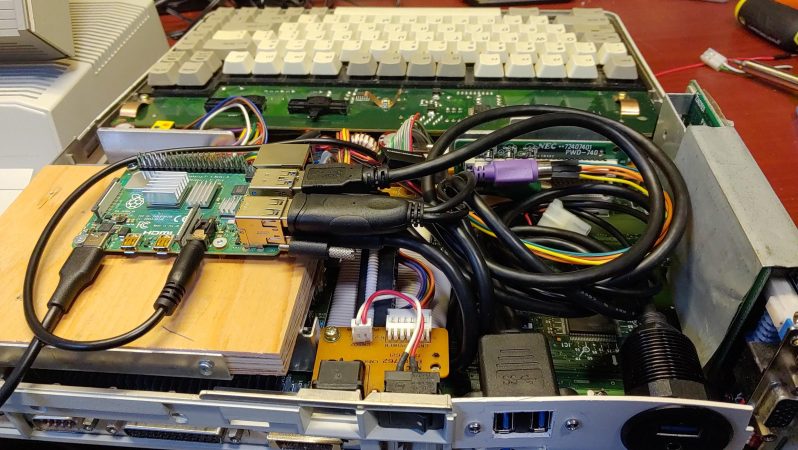
Externally, it looks pretty well stock, and [Cory] has retained as much of the internals as possible. The original power supply remains intact, with power taken off the original HDD’s molex connector. Said power drives a Raspberry Pi, which is small enough to fit inside without any gutting. The original keyboard connects easily enough via a PS/2 to USB adapter, while the passive-matrix LCD has been replaced with a modern screen of the same dimensions. You’d have to be a pretty hard-core purist to mourn that last change.
With emulation on the Pi, he can still have the DOS experience you’d expect from this machine, but its also powerful enough to be useful in the modern day. While we place no bets on whether or not this mod will stay relevant for another 38 years, a more powerful single-board computer or slightly-squished cell phone can be placed in the drive bay instead once the Pi’s ARM processor inevitably starts to look as anemic as the 286 does now.
Not everyone loves this kind of restomod, but we’ve featured more than a few and have a special category for it in our ongoing retrocomputing contest for those who will do everything to keep classics out of the e-waste bin, including remaking them.
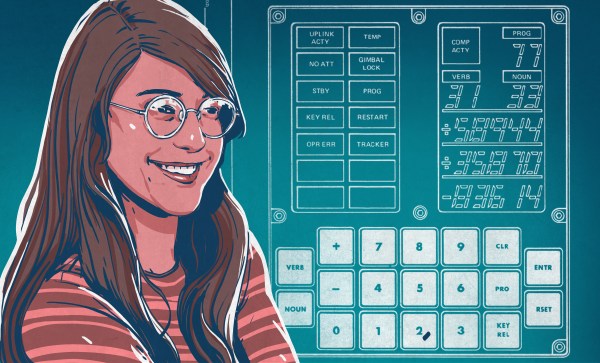
As Director of the Software Engineering Division at the MIT Instrumentation Laboratory, Margaret Hamilton was responsible for the software for the Apollo program. The code she was responsible for ran the lunar lander, and brought multiple missions successfully to the surface of Luna and back to orbital rendezvous. We regret to inform you that she passed on September 30th of 2026, aged 90 years.
Hamilton, with the code that put men on the moon.
If you call yourself a software engineer, you have her to thank. Hamilton didn’t just help define the field through her efforts, she literally coined the term while at NASA in an effort to get “mere” programming taken more seriously. Suffice to say, that ambition was realized, and few see programmer as a low-status career these days.
After decades of obscurity, known only to those willing to dive deep into the Apollo program to discover her work there, Hamilton found deserved fame late in life. Her likeness eventually found its way to classroom posters and even an official LEGO figure. She also got the Presidential Medal of Freedom, but we don’t see how that could possibly compare to being immortalized in LEGO.
Some have called her a feminist icon, blazing a trail for girls and women. While that’s true enough, it’s also thinking perhaps too small. Like the missions she did so much to make successful, Margaret Hamilton blazed a trail for all of humanity.
We wish Margaret’s family the best as she blazes a trail we all must someday follow into that one last undiscovered country. Our own biographical tribute is several years old now, but it bears rereading in light of this news.
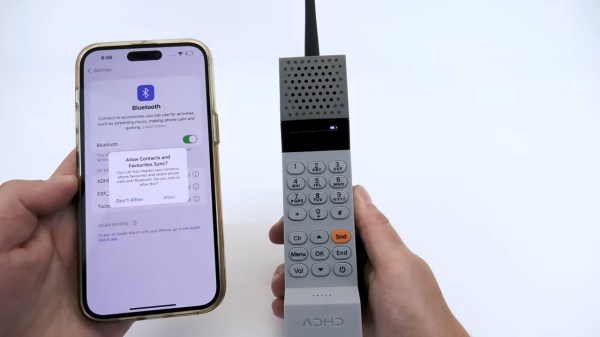
Like more than a few of us , [Kevin Noki] is sick of being pulled out of flow state by that annoyingly addictive black rectangle we all carry around. His solution was to build a phone to escape his phone, in a YouTube video we embedded down below. We’d say that phone is straight out of the 1980s, except it’s not quite a phone. It would perhaps be more accurate to say he’s building a Bluetooth handset– actual telephony remains the province of a professional device with regulatory approval, because getting custom hardware on VoLTE is a nonstarter in many places.
He starts out using an ESP32, because he already had one and why not? It’s got bluetooth, after all. Alas, audio quality he was getting through it was a little too crunchy, so he pivoted to use a dedicated Hands Free Profile (HFP) bluetooth module that is purpose built for exactly this kind of application. He’s selling the design on his website, but given how much detail he shows on screen, recreating your own version would be easy enough to save the quid. You’d be missing out on the STL for the fantastic 80s brick he’s made, which may be the most interesting part of the build to us.
We’d likely have jumped right to CAD and printed out a few iterations of the case until we were happy, but [Kevin] takes a more traditional industrial-design approach, mocking up the phone with XPS foam and a manually-operated hot wire cutter. It’s not a step we see makers take very often, but it pays off here– at least for subtracting material, it’s a very quick way to iterate, and he only needs to do one 3D print for the final version. We also like very high-tech acrylic bending jig, which he uses to put some black LED acrylic over the display.
It’s a lot of work to make you less-likely to grab a phone you still need anyway– remember, there’s no cellular modem in this– but, hey, it beats torturing yourself, or worse, a tamagotchi.