Retrotechtacular: Car Navigation Like It’s 1971

Anyone old enough to have driven before the GPS era probably wonders, as we do, how anyone ever found anything. Navigation back then meant outdated paper maps, long detours because of missed turns, and the far too frequent stops at dingy gas stations for the humiliation of asking for directions. It took forever sometimes, and though we got where we were going, it always seemed like there had to be a better way.

Indeed there was, but instead of waiting for the future and a constellation of satellites to guide the way, some clever folks in the early 1970s had a go at dead reckoning systems for car navigation. The video below shows one, called Cassette Navigation, in action. It consisted of a controller mounted under the dash and a modified cassette player. Special tapes, with spoken turn-by-turn instructions recorded for a specific route, were used. Each step was separated from the next by a tone, the length of which encoded the distance the car would cover before the next step needed to be played. The controller was hooked to the speedometer cable, and when the distance traveled corresponded to the tone length, the next instruction was played. There’s a long list of problems with this method, not least of which is no choice in road tunes while using it, but given the limitations at the time, it was pretty ingenious.

Dead reckoning is better than nothing, but it’s a far cry from GPS navigation. If you’re still baffled by how that cloud of satellites points you to the nearest Waffle House at 3:00 AM, check out our GPS primer for the details.

Continue reading “Retrotechtacular: Car Navigation Like It’s 1971”
Delta Printer Morphs Into CNC Flat Coil Winder

Anyone who has ever wound a coil by hand has probably idly wondered “How do they do this with a machine?” at some point in the tedious process. That’s about when your attention wanders and the wire does what physics wants it to do, with the rat’s nest and cursing as a predictable result.

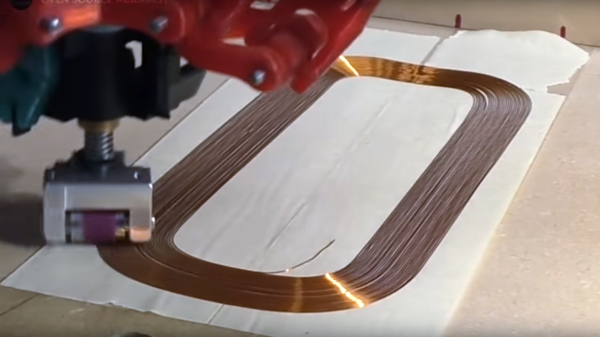
There’s got to be a better way, and [Russ Gries] is on his way to finding it with this proof-of-concept CNC flat coil winder. The video below is a brief overview of what came out of an intensive rapid prototyping session. [Russ] originally thought that moving the coil would be the way to go, but a friend put him onto the idea of using his delta-style 3D-printer to dispense the wire. An attachment somewhat like a drag knife was built, but with a wire feed tube and a metal roller to press the wire down onto an adhesive surface. The wire feed assembly went through a few design iterations before he discovered that a silicone cover was needed for the roller for the wire to properly track, and that the wire spool needed to be fed with as little friction as possible. Fusion 360’s CAM features were used to design the tool paths that describe the coils. It seems quite effective, and watching it lay down neat lines of magnet wire is pretty mesmerizing.

We’ve seen a couple of cylindrical coil winding rigs before, but it looks like this is the first flat coil winder we’ve featured. We can’t help but wonder about the applications. Wireless power transfer comes to mind, as do antennas and coils for RF applications. We also wonder if there are ways to use this to make printed circuit boards. Continue reading “Delta Printer Morphs Into CNC Flat Coil Winder”

Move Over Aluminum: Cast Iron For The Home Foundry

When it comes to choice of metals that can be melted in the home foundry, it’s a little like [Henry Ford]’s famous quip: you can melt any metal you want, as long as it’s aluminum. Not that there’s anything wrong with that; there’s a lot you can accomplish by casting aluminum. But imagine what you could accomplish by recycling cast iron instead.

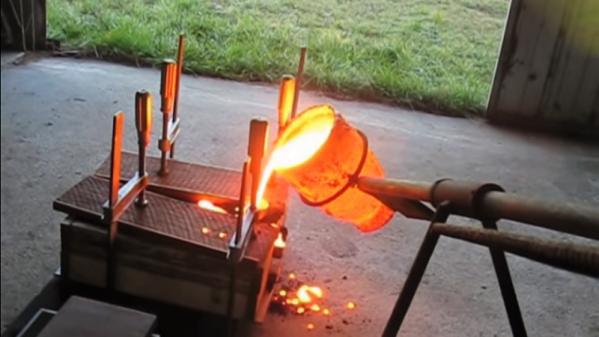
It looks like [luckygen1001] knows a thing or two about slinging hot metal around. The video below shows a fairly expansive shop and some pretty unique tools he uses to recycle cast iron; we were especially impressed with the rig he uses to handle the glowing crucibles from a respectful distance. The cast iron comes from a cheap and abundant source: car disc brake rotors. Usually available free for the asking at the local brake shop, he scores them with an angle grinder and busts them into manageable chunks with a hammer before committing them to the flames. The furnace itself is quite a thing, running on a mixture of diesel and waste motor oil and sounding for all the world like a jet engine starting up. [luckygen1001] had to play with the melt, adding lumps of ferrosilicon alloy to get a cast iron with better machining properties than the original rotors. It’s an interesting lesson in metallurgy, as well as a graphic example of how not to make a flask for molding cast iron.

Cast iron from the home shop opens up a lot of possibilities. A homemade cast aluminum lathe is one thing, but one with cast iron parts would be even better. And if you use a lot of brake rotors for your homebrew cast iron lathe, it might require special handling.

Continue reading “Move Over Aluminum: Cast Iron For The Home Foundry”

The Flight Of The Seagull: Valentina Tereshkova, Cosmonaut

That the Cold War was a tense and perilous time in history cannot be denied, and is perhaps a bit of an understatement. The world stood on the edge of Armageddon for most of it, occasionally stepping slightly over the line, and thankfully stepping back before any damage was done.

As nerve-wracking as the Cold War was, it had one redeeming quality: it turned us into a spacefaring species. Propelled by national pride and the need to appear to be the biggest kid on the block, the United States and the Soviet Union consistently ratcheted up their programs, trying to be the first to make the next major milestone. The Soviets made most of the firsts, making Sputnik and Gagarin household names all over the world. But in 1962, they laid down a marker for a first of epic proportions, and one that would sadly stand alone for the next 19 years: they put the first woman, Valentina Tereshkova, into space.

Continue reading “The Flight Of The Seagull: Valentina Tereshkova, Cosmonaut”

Fail Of The Week: Two Rotors Are Not Better Than Four

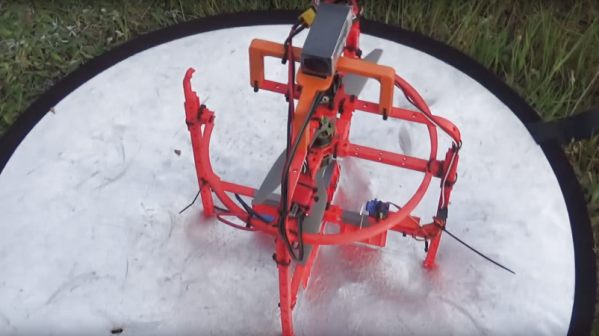
Fair warning: [Paweł Spychalski]’s video is mostly him talking about how bad his “dualcopter” ended up. There are a few sequences of the ill-fated UAV undergoing flight tests, most of which seem to end with it doing a reasonable impression of a post-hole auger. We have to admit that it’s a pretty poor drone. But one can only truly fail if one fails to have some fun doing it, [Paweł] enjoyed considerable success, at least judging by the glee with which he repeatedly cratered the craft.

The overall idea seems to make sense, with coaxial props mounted in the middle of a circular 3D-printed frame. Mounted below the props are crossed vanes controlled by two servos. The vanes sit in the rotor wash and provide pitch and roll control, while yaw and thrust are controlled by varying the speeds of the counter-rotating props. [Paweł] knew going in that this was a sketchy aerodynamic design, and was surprised it performed as well as it did. But with ground effects limiting roll and pitch control close to the ground, the less-than-adequate thrust due to turbulence between the rotors, and the tendency for the center of mass and the center of gravity to get out whack with each other, all made for a joyously unstable and difficult to control aircraft.

Despite the poor performance, [Paweł] has plans for a Mark II dualrotor, a smaller craft with some changes based on what he learned. He’s no slouch at pushing the limits with multirotors, with 3D-printed racing quad frames and using LoRa for control beyond visual range. Still, we’re sure he’d appreciate constructive criticism in the comments, and we wish him luck with the next one.

Continue reading “Fail Of The Week: Two Rotors Are Not Better Than Four”

A Guide To Audio Amps For Radio Builders

For hams who build their own radios, mastering the black art of radio frequency electronics is a necessary first step to getting on the air. But if voice transmissions are a goal, some level of mastery of the audio frequency side of the equation is needed as well. If your signal is clipped and distorted, the ham on the other side will have trouble hearing you, and if your receive audio is poor, good luck digging a weak signal out of the weeds.

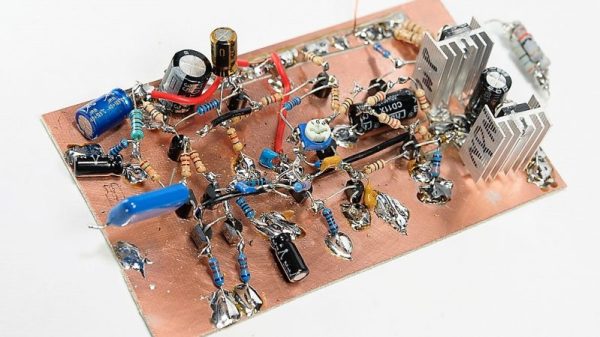
Hams often give short shrift to the audio in their homebrew transceivers, and [Vasily Ivanenko] wants to change that with this comprehensive guide to audio amplifiers for the ham. He knows whereof he speaks; one of his other hobbies is jazz guitar and amplifiers, and it really shows in the variety of amps he discusses and the theory behind them. He describes a number of amps that perform well and are easy to build. Most of them are based on discrete transistors — many, many transistors — but he does provide some op amp designs and even a design for the venerable LM386, which he generally decries as the easy way out unless it’s optimized. He also goes into a great deal of detail on building AF oscillators and good filters with low harmonics for testing amps. We especially like the tip about using the FFT function of an oscilloscope and a signal generator to estimate total harmonic distortion.

The whole article is really worth a read, and applying some of these tips will help everyone do a better job designing audio amps, not just the hams. And if building amps from discrete transistors has you baffled, start with the basics: [Jenny]’s excellent Biasing That Transistor series.

[via Dangerous Prototypes]

Tricking A Vintage Clock Chip Into Working On 50-Hz Power

Thanks to microcontrollers, RTC modules, and a plethora of cheap and interesting display options, digital clock projects have become pretty easy. Choose to base a clock build around a chip sporting a date code from the late 70s, though, and your build is bound to be more than run-of-the-mill.

This is the boat that [Fran Blanche] finds herself in with one of her ongoing projects. The chip in question is a Mostek MK50250 digital alarm clock chip, and her first hurdle was find a way to run the clock on 50 Hertz with North American 60-Hertz power. The reason for this is a lesson in the compromises engineers sometimes have to make during the design process, and how that sometimes leads to false assumptions. It seems that the Mostek designers assumed that a 24-hour display would only ever be needed in locales where the line frequency is 50 Hz. [Fran], however, wants military time at 60 Hz, so she came up with a circuit to fool the chip. It uses a 4017 decade counter to divide the 60-Hz signal by 10, and uses the 6-Hz output to turn on a transistor that pulls the 60-Hz output low for one pulse. The result is one dropped pulse out of every six, which gives the Mostek the 50-Hz signal it needs. Sure, the pulse chain is asymmetric, but the chip won’t care, and [Fran] gets the clock she wants. Pretty clever.

[Fran] has been teasing this clock build for a while, and we’re keen to see what it looks like. We hope she’ll be using these outsized not-quite-a-light-pipe LED displays or something similar.

Continue reading “Tricking A Vintage Clock Chip Into Working On 50-Hz Power”