Mirror, Mirror, On Your Cam, Show Us What You’ve Drawn By Hand

Working and learning from home may be the new norm, and if IKEA shelves are any indication, folks are tricking out their home office with furniture, gadgets, and squishy chairs. While teleconferencing has proven to be an invaluable tool, paper documents aren’t going down with out a fight.

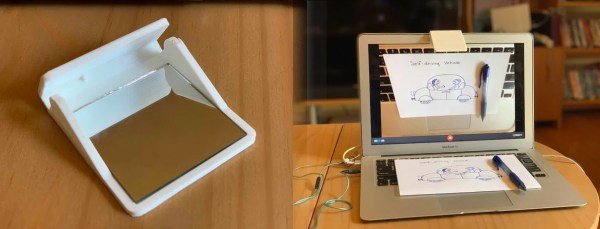
Unfortunately dedicated document cameras require significant space and monies, so they’re impractical if you only share once in a while. [John Umekubo] didn’t want students and teachers hobbled by the same costs and inconveniences, so he modeled a mirror holder that slides over a laptop’s webcam and directs the view downward.

[John]’s adventures started with a Twitter post, as seen below, but the responses were so encouraging that he published his design on Thingiverse for everyone. There’s also a version that can be laser cut out of cardboard, though we imagine a pair of scissors would work in a pinch. He admits there’s already a consumer model, but wasn’t planning to sell them anyway. Like us, he wants to get people to share their work.

We recently covered a simpler version of the same idea in use at Northwestern University, and we’ve seen a similar hack that gives a split-screen effect to sketch and maintain eye contact. If you want to share the view in your room, we have a Raspberry Pi streaming option that’s worth checking out.

Continue reading “Mirror, Mirror, On Your Cam, Show Us What You’ve Drawn By Hand”
Patience Beats Rage-Quit In Shattered Xbox Controller Repair

There are negative-one hacks to this project. Someone lost at their game, lost their temper, then raged at their Xbox controller with some horsepower. The result is that [Taylor Burley] gets a free controller with a non-responsive joystick out of the deal, and since he had nothing to lose, he decided to heat up the iron and bring the controller back to life.

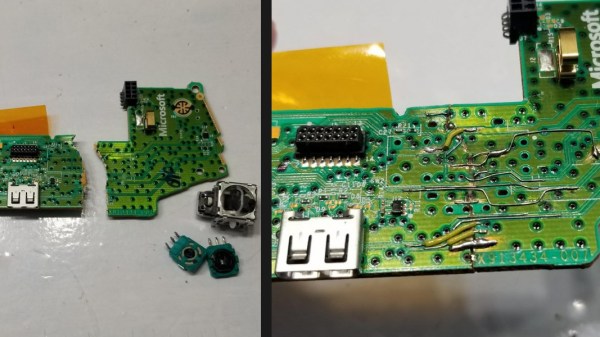
The majority of the project is told in pictures and through the narration in the video below. In removing the joystick, [Taylor] opts for the technique of doping the connections with fresh solder (we assume containing lead for easier melting) before reaching for the desoldering wick. The diagnosis stage is brief because when the joystick lifts away, the PCB falls apart into two separate pieces! The next step was to glue the two halves together with cyanoacrylate to get into the nooks and crannies, then epoxy to provide structure. Solder bridges were not going to jump that gap, so he used 30ga wire and attached it wherever he could scrape away some solder mask. Best of all, it worked when he reattached the joystick. Job well done.

Xbox controllers are not a scarce commodity, so people do not spend their idle hours fixing them, but not many people can claim experience. Maybe someday the stakes will be higher and he will have the courage to repair vintage electronics. We won’t rant on how things aren’t built to last, and how we don’t train people to fix things. Today, we want to focus on someone who used their time to repair and learn.

Continue reading “Patience Beats Rage-Quit In Shattered Xbox Controller Repair”

Greeking Out With Arduinos

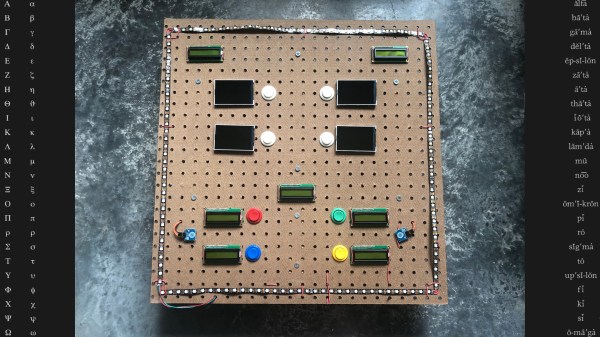
Learning a new language is hard work, but they say that the best way to learn something is to teach it. [Angeliki Beyko] is learning Greek, and what better way to teach than to build a vocabulary flash-card game from Arduinos, color screens, 1602 text screens, and arcade buttons? After the break, we have a video from the creator talking about how to play, the hardware she chose, and what to expect in the next version.

Pegboard holds most of the hardware except the color screens, which are finicky when it comes to their power source. The project is like someone raided our collective junk drawers and picked out the coolest bits to make a game. Around the perimeter are over one hundred NeoPixels to display the game progress and draw people like a midway game. Once invested, you select a category on the four colored arcade buttons by looking at the adjacent LCD screens’ titles. An onboard MP3 shield reads a pseudo-random Greek word and displays it on the top-right 1602 screen in English phonetics. After that, it is multiple choice with your options displaying in full-color on four TFT monitors. A correct choice awards you a point and moves to the next word, but any excuse to mash on arcade buttons is good enough for us.

[Angeliki] does something we see more often than before, she’s covering what she learned, struggled with, would do differently, and how she wants to improve. We think this is a vital sign that the hacker community is showcasing what we already knew; hackers love to share their knowledge and improve themselves.

Typing Greek with a modern keyboard will have you reaching for an alt-code table unless you make a shortcut keyboard, and if you learn Greek, maybe you can figure out what armor they wore to battle.

Continue reading “Greeking Out With Arduinos”

Into The Belly Of The Beast With Placemon

No, no, at first we thought it was a Pokemon too, but Placemon monitors your place, your home, your domicile. Instead of a purpose-built device, like a CO detector or a burglar alarm, this is a generalized monitor that streams data to a central processor where machine learning algorithms notify you if something is awry. In a way, it is like a guard dog who texts you if your place is unusually cold, on fire, unlawfully occupied, or underwater.

[anfractuosity] is trying to make a hacker-friendly version based on inspiration from a scientific paper about general-purpose sensing, which will have less expensive components but will lose accuracy. For example, the article suggests thermopile arrays, like low-resolution heat-vision, but Placemon will have a thermometer, which seems like a prudent starting place.

The PCB is ready to start collecting sound, temperature, humidity, barometric pressure, illumination, and passive IR then report that telemetry via an onboard ESP32 using Wifi. A box utilizing Tensorflow receives the data from any number of locations and is training to recognize a few everyday household events’ sensor signatures. Training starts with events that are easy to repeat, like kitchen sounds and appliance operations. From there, [anfractuosity] hopes that he will be versed enough to teach it new sounds, so if a pet gets added to the mix, it doesn’t assume there is an avalanche every time Fluffy needs to go to the bathroom.

We have another outstanding example of sensing household events without directly interfacing with an appliance, and bringing a sensor suite to your car might be up your alley.

The Most Expensive D20 You’ll See Today

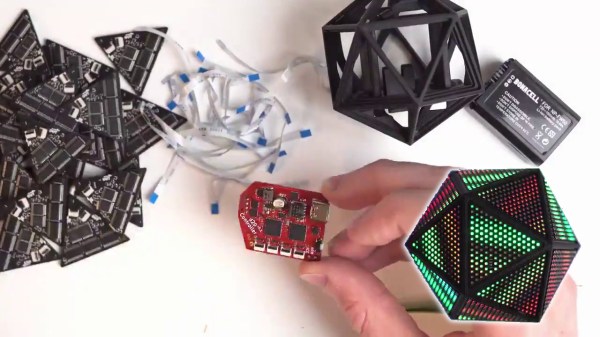
Roll your negotiation skill, because this d20 is a hefty one. The Tweet is also below. We are charmed by [Greg Davill]’s twenty-sided LED contraption, but what do we call it? Is it a device? A sculpture? A die? Even though “d20” is right on his custom controller PCB, we don’t think this will grace the table at the next elf campaign since it is rather like taking a Rolls Royce to the grocery store. Our builder estimates the price tag at $350 USD and that includes twenty custom PCB light panels with their components, a controller board, one battery pack, and the 3D printed chassis that has to friction-fit the light faces.

Power and communication for all the panels rely on twenty ribbon cables daisy-chained throughout the printed scaffolding, which you can see in the picture above. [Greg] made a six-sided LED cube last year, and there are more details for it, but we suspect he learned his lesson about soldering thousands of lights by hand. There are one-hundred-twenty LEDs per panel, times twenty, that is over two-thousand blinkenlights. We don’t yet have specs on the controller, but last time he used a SAMD51 processor to support over three-thousand lights. We don’t know where he’ll go next, but we’re game if he wants to make a chandelier for Hackaday’s secret underground lair.

(Editor’s Note: If you were at Supercon last year, and you got to play with this thing in the flesh, it’s worth it!)

Continue reading “The Most Expensive D20 You’ll See Today”

Digital Expression Via Harmonica

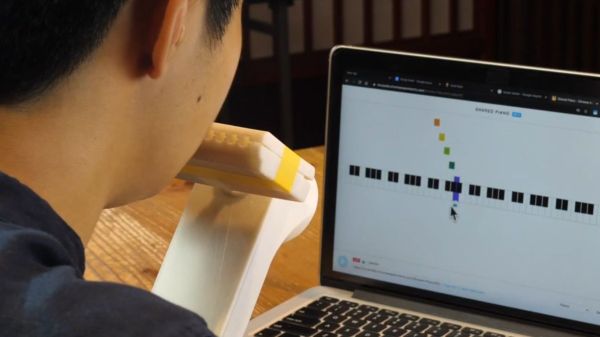
There is a good chance you clicked on this article with a mouse, trackball, trackpad, or tapped with your finger. Our hands are how most of us interact with the digital world, but that isn’t an option for everyone, and [Shu Takahashi] wants to give them a new outlet to express themselves. Some folks who cannot use their hands will be able to use the Magpie MIDI, which acts as a keyboard, mouse, MIDI device, and eventually, a game controller. This universal Human Interface Device (HID) differs from a mouth-operated joystick because it has air pressure sensors instead of buttons. The sensors can recognize the difference between exhalation and inhalation, so the thirteen ports can be neutral, positive, or negative, which is like having twenty-six discrete buttons.

The harmonica mounts on an analog X-Y joystick to move a mouse pointer or manipulate MIDI sound like a whammy bar. [Shu] knows that a standard harmonica has ten ports, but he picked thirteen because all twenty-six letters are accessible by a puff or sip in keyboard mode. The inputs outnumber the Arduino Leonardo’s analog inputs, so there is a multiplexor to read all of them. There was not enough time to get an Arduino with enough native ports, like a Teensy, with HID support baked in. Most of the structure is 3D printed, so parts will be replaceable and maybe even customizable.

Even with two working hands, we like to exercise different hardware, but the harmonica is a nifty tool to have attached to your computer.

Continue reading “Digital Expression Via Harmonica”

A Graphene Mouth Screen

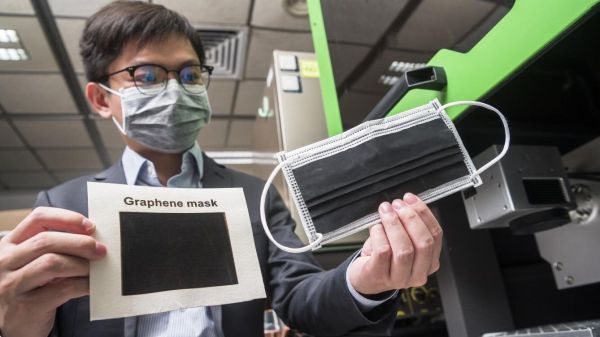
We are all intimate with face coverings to slow the spread of the coronavirus. Some are reusable, and some become waste after one use. [Dr. Ye Ruquan] and a research team from City University of Hong Kong, CityU, are developing an inexpensive reusable mask with outstanding antibacterial properties, and, get this, the graphene it contains will generate a tiny current when moistened by human breath. There isn’t enough power to charge your phone or anything, but that voltage drops as the masks get dirty, so it can help determine when it needs cleaning. The video after the break shows the voltage test, and it reminds us of those batteries.

All the remarkable qualities of this mask come from laser-induced graphene. The lab is producing LIG by lasering polyimide film with a commercial CO2 infrared model. In a speed test, the process can convert 100cm² in ninety seconds, so the masks can be made more cheaply than an N95 version with that melt-blown layer that is none too good for the earth. Testing the antibacterial properties against activated carbon fiber and blown masks showed approximately 80% of the bacteria is inert after 8 hours compared to the others in the single digits. If you put them in the sun for 10 minutes, blown fabric goes to over 85%, but the graphene is 99.998%, which means that one bacteria in 50K survives. The exact mechanism isn’t known, but [Dr. Ye] thinks it may have something to do with graphene’s sharp edges and hydrophobic quality. A couple of coronavirus species were also affected, and the species that causes COVID-19 will be tested this year.

An overly damp mask is nothing to sneeze at, so keep yourself in check and keep yourself fabulous.

Continue reading “A Graphene Mouth Screen”