[Radical Brad] has played around with FPGAs, video signals, and already has a few astonishing projects of bitbanged VGA on his resume. Now he’s gone insane. He’s documenting a build over on the 6502.org forums of a computer with Amiga-quality graphics built out of nothing but a 65C02, a few SRAM chips, and a whole pile of logic chips.
The design goals for this project are to build a video game system with circa 1980 parts and graphics a decade ahead of its time. The video output is VGA, with 400×300 resolution, in glorious eight-bit color. The only chips in this project more complex than a shift register are a single 65c02 and a few (modern) 15ns SRAMs. it’s not a build that would have been possible in the early 80s, but the only thing preventing that would be the slow RAM chips of the era.
So far, [Radical] has built a GPU entirely out of 74-series logic that reads a portion of RAM and translates that to XY positions, colors, pixels, and VGA signals. There’s support for alpha channels and multiple sprites. The plan is to add sound hardware with support for four independent digital channels and 1 Megabyte of sample memory. It’s an amazingly ambitious project, and becomes even more impressive when you realize he’s doing all of this on solderless breadboards.
[Brad] will keep updating the thread on 6502.org until he’s done or dies trying. So far, it’s looking promising. He already has a bunch of Boing balls bouncing around a display. You can check out a video of that below.
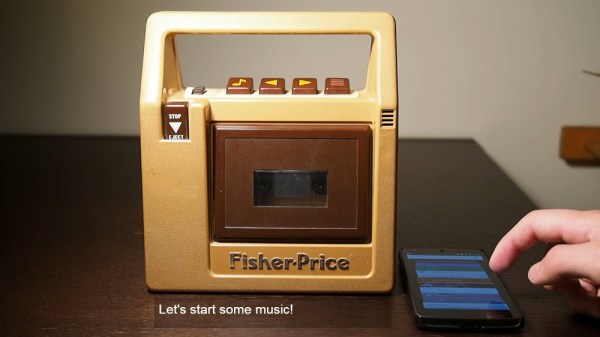
A good hacker hates to throw away electronics. We think [Matt Gruskin] must be a good hacker because where a regular guy would see a junky old 1980’s vintage Fisher Price cassette player, [Matt] saw a retro stylish Bluetooth speaker. His hack took equal parts of electronics and mechanics. It even required some custom 3D printing.
You might think converting a piece of old tech to Bluetooth would be a major technical challenge, but thanks to the availability of highly integrated modules, the electronics worked out to be fairly straightforward. [Matt] selected an off the shelf Bluetooth module and another ready-to-go audio amplifier board. He built a custom board to convert the stereo output to mono and hold the rotary encoder he used for the volume control. An Arduino (what else?) reads the encoder and also provides 3.3V to some of the other electronics.
The really interesting part of the hack is the mechanics. [Matt] managed to modify the existing mechanical buttons to drive the electronics using wire and hot glue. He also added a hidden power switch that doesn’t change the device’s vintage look. Speaking of mechanics, there’s also a custom 3D printed PCB holder allowing for the new board to fit in the original holder. This allows [Matt] to keep the volume control in its original location
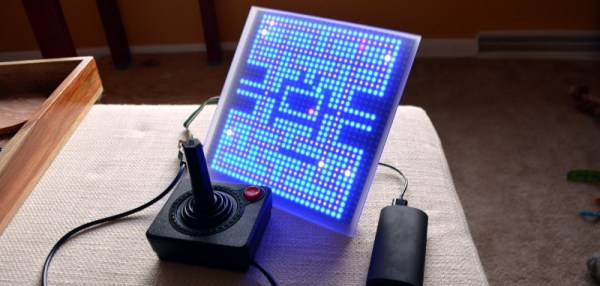
I usually see retro-gaming projects using tiny screens with a fair number of pixels (64×64) but what I really like is the look of making every pixel count. With this in mind I built 1-Pixel Pac-Man, the classic coin-op experience but with characters that consist of just one pixel. Playing a throw-back like this wouldn’t be the same without some vintage controls so I picked up an Atari joystick, patched it into a microcontroller, and started coding. Check it out:
Smartmatrix Bundle
32×32 RGB panel with acrylic diffuser
Back of the Smartmatrix
This piece of hardware made the project build really easy: the Smartmatrix. [Louis Beaudioin] developed the Smartmatrix and it’s been in the Hackaday Store for a while now. The display module itself is a commodity item that is used in LED billboards. There are shrouded headers on the back of the panels, to the left and right sides, which allow them to be daisy chained. The Smartmatrix PCB plugs into one of these shields, provides a soldering footprint for the Teensy 3.1 which drives the display, and gives you the wiring to connect screw terminals from the PCB to the power terminals on the module. Why the need for beefy power jumpers? At full white the thing can draw about 3.5A — don’t worry there’s a power supply included in the bundle.
Also integral to making this look good is the diffuser panel which is frosted acrylic. The Smartmatrix is designed to be housed in a shadowbox frame; it even includes a frame backer board with a cut-out for the Teensy 3.1 so it can be programmed without opening the thing up. I like looking at the guts so I’m leaving my free floating until I come up with an interesting way to mount everything as one unit.
Programming Pac-Man from the Ground Up
If you haven’t looked into it before, the ghost AI and gameplay details for Pac-Man are absolutely brilliant. [Toru Iwatani] did a masterful job with the original, and you should take a look at all of the analysis that has been done over the years. The best collection I could find was the Pac-Man Dossier and I based most of my code on the rules described there.
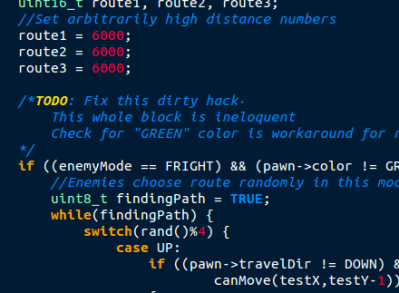
Basically the ghosts have two modes, chase and scatter. The modes set the enemy targets differently; to points at the four corners of the board in scatter, and to points relative to the player in chase. The relative part is key; only the red enemy actually chases you. Another one of them looks at the red enemy’s distance and angle, and targets the reflection of that vector. Really easy, really clever, and results in enemy behavior that’s believable. It isn’t just the enemy movement, little touches like a speed penalty (1/60 of a second) for each dot the player gobbles up means the enemies can catch up if you continuously eat, but you can escape by taking the path already-eaten.
Library, DMA, and Extra Hardware
Teensy 3.1
DB9 Connector for Joystick
Extras in the Bundle
Kickstarter remote and RTC Module
The hardware and software running the Smartmatrix made the display portions of the project really simple. First off, the Teensy 3.1 is fast, running at 96MHz in this case. Second, it has Direct Memory Access (DMA) which [Louis] used in the Smartmatrix library. This means that driving the display takes almost no CPU time at all, leaving the rest for your own use. This example of a game is under-utilizing this power… it’s totally capable of full-motion video and calculating amazing visualizations on the fly.
The PCB hosting the Teensy 3.1 breaks out several pins to one side. I’m not sure what I’ll add in the future so I actually used the extra surface-mount IO pins on the bottom of the Teensy to connect the Atari joystick (which is simply a set of switches). The are enough pads for two joysticks so I used pin sockets to interface the Teensy to the PCB so that I can get to it again later.
The kit also includes an IR receiver and remote, and also a microSD card to loading animations (there’s an SD socket on the PCB). The bundle in the Hackaday Store is a kit you solder yourself, but [Louis’] company, Pixelmatix, has a Kickstarter running for fully-assembled versions that come with a black remote and sound-visualization hardware.
Future Improvements
The game is fully working, but there are a few key things that I really want to add. The Teensy 3.1 has a single DAC pin available. I’m fairly certain the original coin-op game had mono audio. It should be possible to reproduce the sound quite accurately with this board. That would really make the project pop.
There are also a bunch of touch-ups that need to happen. I’d like to add an animation when the player is eaten by an enemy, and a countdown before the level restarts. The score, shown in binary on the right column, should be scrolled out in decimal when the game ends, and what’s a coin-op recreation without a high-score screen?
It’s no secret that Maker Faire is highly geared toward the younger crowd. This doen’t mean the Faire is completely devoid of the historic; the Bay Area Maker Faire is right in the heart of the beginnings of the computer industry, and a few of the booths are showing off exactly how far computers have come over the last forty years.
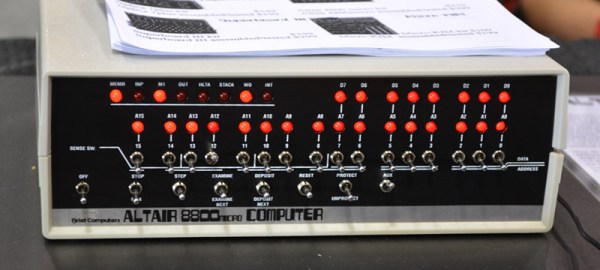
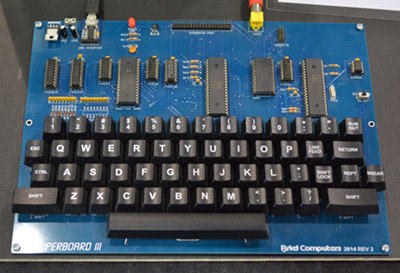
[Vince Briel] of Briel Computers has a booth showing off his wares, mostly modern reimaginings of vintage computers. His table is loaded up with replica 1s, a board that’s much smaller but still completely compatible with the Apple I. The MicroKIM made an appearance, but the crown jewel is [Vince]’s Superboard III, a replica of the Ohio Scientific Superboard II. It’s your basic 6502 computer with 32k of RAM, but unlike just about every other modern retrocomputer out there, [Vince] put the keyboard right on the main board.
The switches are Cherry MX, the keys are from WASDkeyboards. [Vince] is actually getting a lot of interest in making modern ASCII keyboards to replace the old and busted boards that came in the home computers of the 70s and 80s. That might be a project [Vince] will release sometime in the future.
A much, much smaller version of the Altair
The Superboard III
MicroKIM
The Replica I, fully compatible Apple I replica
[Jef Raskin], the Swift Card, and the Canon Cat
[Steve Jobs] may have been the father of the Macintosh, but he was, by no means, solely responsible for the Mac. It was a team of people, and when you talk about the UI of the Mac, the first name that should come up is [Jef Raskin].
One of [Jef Raskin]’s finest works was the Swyft Card, an add-on to the Apple II that was basically just a ROM card that had an OS and Forth interpreter on it. The distinguishing feature of the Swyft card was the use of ‘leap’ keys, a simple way to change contexts when using the computer. We’ve seen replicas of the Swyft card before, courtesy of [Mike Willegal] at the Vintage Computing Festival East.
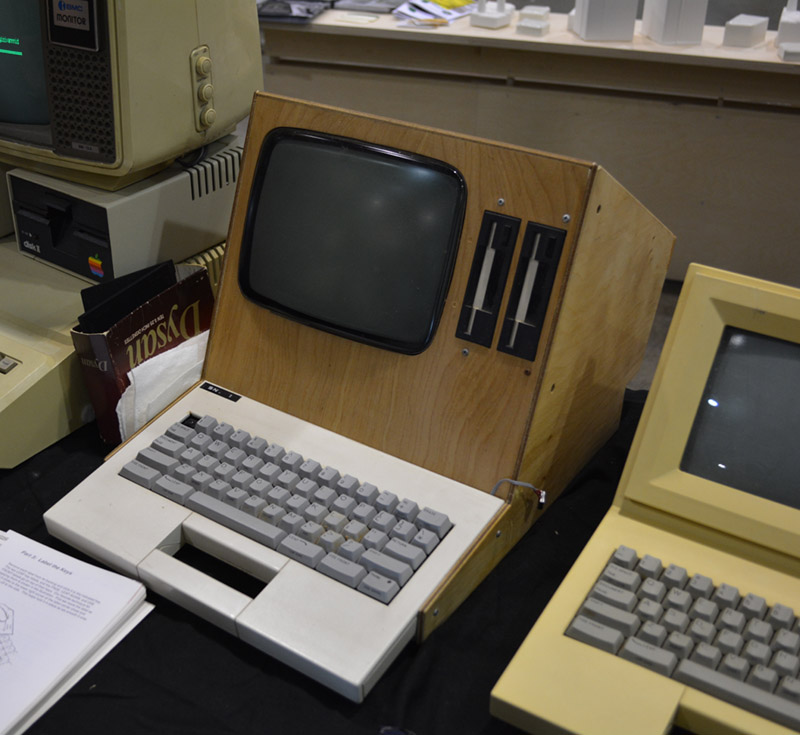
[Dwight Elvey] of the vintage-computer.com forum brought a few extra special items related to [Raskin] and the Canon Cat. The first was a Swyft card installed in an Apple IIe. The second was a prototype Swyft computer, with SERIAL NUMBER 1 printed on a Dymo label and fixed to the case.
The ‘woodie’, as [Dwight] calls it, has two 1.44 MB disk drives, of which half of the disk is actually usable. [Dwight] didn’t take the machine apart, but I’m 99% sure the CRT in it is the exact same tube found in early 9″ Macs.
Also in [Dwight]’s display is a production Swyft computer and a Canon Cat, the final iteration of [Jef Raskin]’s idea of what a text-based computer should be.
The vintage-computer booth also had a few interesting retrocomputers including a Commodore 128D, the Apple made, Bell & Howell branded Apple II, and an Amiga 2000. Right next door was the Computer History Museum, who brought a very kid-friendly storage medium display. Showing a 10-year-old an 8″ disk is fun.
Analog computer from the Computer History Museum. It was display Chua’s Circuit.
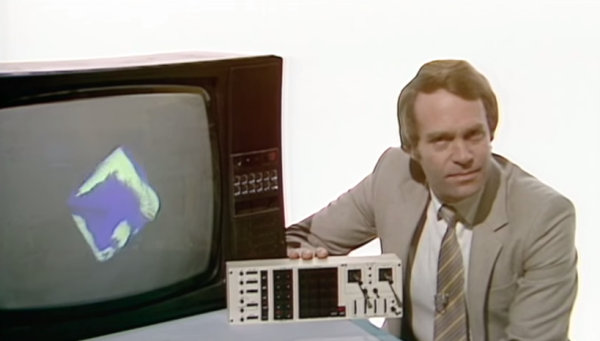
We all know what Computer-Generated Imagery (CGI) is nowadays. It’s almost impossible to get away from it in any television show or movie. It’s gotten so good, that sometimes it can be difficult to tell the difference between the real world and the computer generated world when they are mixed together on-screen. Of course, it wasn’t always like this. This 1982 clip from BBC’s Tomorrow’s World shows what the wonders of CGI were capable of in a simpler time.
In the earliest days of CGI, digital computers weren’t even really a thing. [John Whitney] was an American animator and is widely considered to be the father of computer animation. In the 1940’s, he and his brother [James] started to experiment with what they called “abstract animation”. They pieced together old analog computers and servos to make their own devices that were capable of controlling the motion of lights and lit objects. While this process may be a far cry from the CGI of today, it is still animation performed by a computer. One of [Whitney’s] best known works is the opening title sequence to [Alfred Hitchcock’s] 1958 film, Vertigo.
Later, in 1973, Westworld become the very first feature film to feature CGI. The film was a science fiction western-thriller about amusement park robots that become evil. The studio wanted footage of the robot’s “computer vision” but they would need an expert to get the job done right. They ultimately hired [John Whitney’s] son, [John Whitney Jr] to lead the project. The process first required color separating each frame of the 70mm film because [John Jr] did not have a color scanner. He then used a computer to digitally modify each image to create what we would now recognize as a “pixelated” effect. The computer processing took approximately eight hours for every ten seconds of footage. Continue reading “Retrotechtacular: The Early Days Of CGI”→
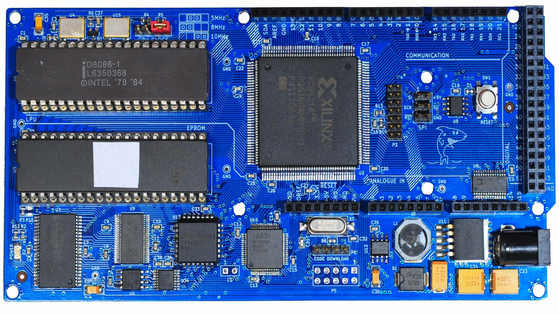
Sometimes it is a blessing to have some spare time on your hands, specially if you are a hacker with lots of ideas and skill to bring them to life. [Matt] was lucky enough to have all of that and recently completed an ambitious project 8 months in the making – a Non-Arduino powered by the giant of computing history – Intel’s 8086 processor. Luckily, [Matt] provides a link to describe what Non-Arduino actually means; it’s a board that is shield-compatible, but not Arduino IDE compatible.
He was driven by a desire to build a single board computer in the old style, specifically, one with a traditional local bus. In the early days, a System Development Kit for Intel’s emerging range of microprocessors would have involved a fair bit of discrete hardware, and software tools which were not all too easy to use.
Back in his den, [Matt] was grappling with his own set of challenges. The 8086 is a microprocessor, not a microcontroller like the AVR, so the software side of things are quite different. He quickly found himself locking horns with complex concepts such as assembly bootstrapping routines, linker scripts, code relocation, memory maps, vectors and so on. The hardware side of things was also difficult. But his goal was learning so he did not take any short cuts along the way.
[Matt] documented his project in detail, listing out the various microprocessors that run on his 8OD board, describing the software that makes it all run, linking to the schematics and source code. There’s also an interesting section on running Soviet era (USSR) microprocessor clones on the 8OD. He is still contemplating if it is worthwhile building this board in quantities, considering it uses some not so easy to source parts. If you are interested in contributing to the project, you could get lucky. [Matt] has a few spares of the prototypes which he is willing to loan out to anyone who can can convince him that they could add some value to the project.
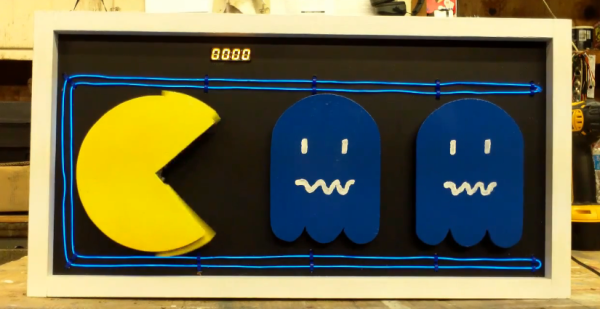
[Bob’s] Pac-Man clock is sure to appeal to the retro geek inside of us all. With a tiny display for the time, it’s clear that this project is more about the art piece than it is about keeping the time. Pac-Man periodically opens and closes his mouth at random intervals. The EL wire adds a nice glowing touch as well.
The project runs off of a Teensy 2.0. It’s a small and inexpensive microcontroller that’s compatible with Arduino. The Teensy uses an external real-time clock module to keep accurate time. It also connects to a seven segment display board via Serial. This kept the wiring simple and made the display easy to mount. The last major component is the servo. It’s just a standard servo, mounted to a customized 3D printed mounting bracket. When the servo rotates in one direction the mouth opens, and visa versa. The frame is also outlined with blue EL wire, giving that classic Pac-Man look a little something extra.
The physical clock itself is made almost entirely from wood. [Bob] is clearly a skilled wood worker as evidenced in the build video below. The Pac-Man and ghosts are all cut on a scroll saw, although [Bob] mentions that he would have 3D printed them if his printer was large enough. Many of the components are hot glued together. The electronics are also hot glued in place. This is often a convenient mounting solution because it’s relatively strong but only semi-permanent.
[Bob] mentions that he can’t have the EL wire and the servo running at the same time. If he tries this, the Teensy ends up “running haywire” after a few minutes. He’s looking for suggestions, so if you have one be sure to leave a comment. Continue reading “Pac-Man Clock Eats Time, Not Pellets”→









![A Collection of [Jef Raskin]'s work](https://i0.wp.com/hackaday.com/wp-content/uploads/2015/05/jef-raskin.jpg?w=796&h=353&ssl=1 "Jef Raskin")