Prototype Robot For Omniwheel Bicycle

For all its ability to advance modern society in basically every appreciable way, science still has yet to explain some seemingly basic concepts. One thing that still has a few holes in our understanding is the method by which a bicycle works. Surely, we know enough to build functional bicycles, but like gravity’s inclusion into the standard model we have yet to figure out a set of equations that govern all bicycles in the universe. To push our understanding of bicycles further, however, some are performing experiments like this self-balancing omniwheel bicycle robot.

Functional steering is important to get the bicycle going in the right direction, but it’s also critical for keeping the bike upright. This is where [James Bruton] is putting the omniwheel to the test. By placing it at the front of the bike, oriented perpendicularly to the direction of travel, he can both steer the bicycle robot and keep it balanced. This does take the computational efforts of an Arduino Mega paired with an inertial measurement unit but at the end [James] has a functional bicycle robot that he can use to experiment with the effects of different steering methods on bicycles.

While he doesn’t have a working omniwheel bicycle for a human yet, we at least hope that the build is an important step on the way to [James] or anyone else building a real bike with an omniwheel at the front. Hopefully this becomes a reality soon, but in the meantime we’ll have to be content with bicycles with normal wheels that can balance and drive themselves.

Continue reading “Prototype Robot For Omniwheel Bicycle”

Pressure Gauge Built In A Vacuum

Necessity might be the mother of all invention, but we often find that inventions around here are just as often driven by expensive off-the-shelf parts and a lack of willingness to spend top dollar for them. More often than not, we find people building their own tools or parts as if these high prices are a challenge instead of simply shrugging and ordering them from a supplier. The latest in those accepting the challenge of building their own parts is [Advanced Tinkering] who needed a specialty pressure gauge for a vacuum chamber.

In this specific case, the sensor itself is not too highly priced but the controller for it was the deal-breaker, so with a trusty Arduino in hand a custom gauge was fashioned once the sensor was acquired. This one uses an external analog-to-digital converter to interface with the sensor with 16-bit resolution, along with some circuitry to bring the ~8 V output of the sensor down to the 5 V required by the microcontroller. [Advanced Tinkering] wanted a custom live readout as well, so a 3D printed enclosure was built that includes both an LCD readout of the pressure and a screen with a graph of the pressure over time.

For anyone else making sensitive pressure measurements in a vacuum chamber, [Advanced Tinkering] made the project code available on a GitHub page. It’s a great solution to an otherwise overpriced part provided you have the time to build something custom. If you’re looking for something a little less delicate, though, take a look at this no-battery pressure sensor meant to ride along on a bicycle wheel.

Continue reading “Pressure Gauge Built In A Vacuum”

An Off-Grid Makeshift Cell Network

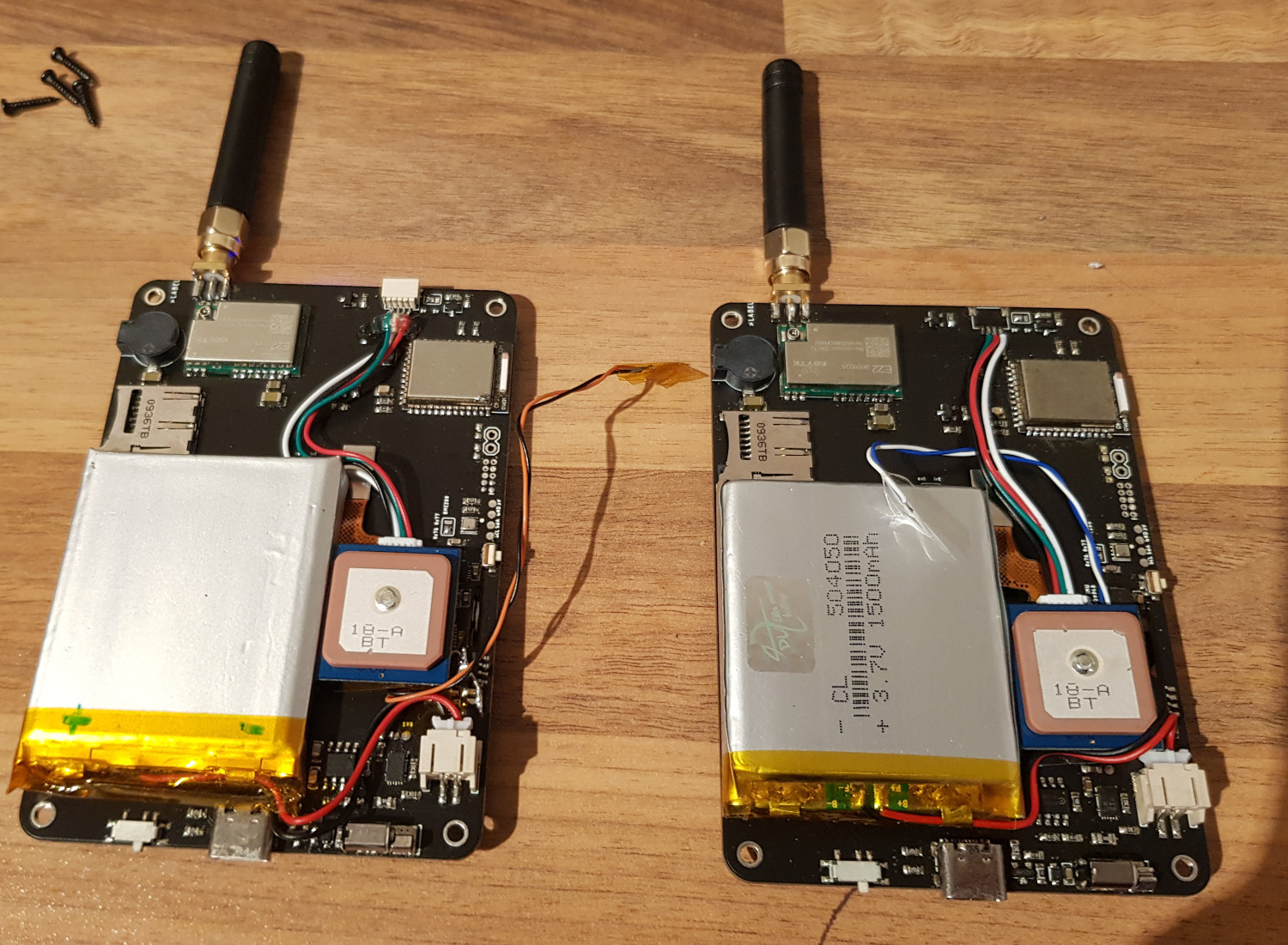
When traveling into the wilderness with a group of people, it’s good to have a method of communications set up both for safety and practicality. In the past people often relied on radios like FRS, CB, or ham bands if they had licenses, but nowadays almost everyone has a built-in communications device in their pocket that’s ready to use. Rather than have all of his friends grab a CB to put in their vehicle for their adventures together, [Keegan] built an off-grid network which allows any Android phone to communicate with text even if a cell network isn’t available.

The communications system is built on the LoRa communications standard for increased range over other methods like WiFi using a SX1278 chip and an ESP8266. The hardware claims a 10 km radius using this method which is more than enough for [Keegan]’s needs. Actually connecting to the network is only half of the solution though; the devices will still need a method of communication. For that, a custom Android app was created which allows up to 8 devices to connect to the network and exchange text messages with each other similar to a group text message.

For off-grid adventures a solution like this is an elegant solution to a communications problem. It uses mostly existing hardware since everyone carries their own phones already, plus the LoRa standard means that even the ESP8266 base station and transmitter are using only a tiny bit of what is likely battery power. If you’re new to this wireless communications method, we recently featured a LoRa tutorial as well.

RC Snowmobile Makes Tracks On Ice

With all the futuristic technology currently at our disposal, it seems a little bizarre that most passenger vehicles are essentially the same thing that they were a century ago. Four wheels, a motor, and some seats would appear to be a difficult formula to beat. But in the 3D printing world where rapid prototyping is the name of the game, some unique vehicle designs have been pushed out especially in the RC world. One of the latest comes to us from [RCLifeOn] in the form of a single-wheeled RC snowmobile.

While not a traditional snowmobile with tracks, this one does share some similarities. It has one drive wheel in the back printed with TPR for flexibility and it also includes studs all along its entire circumference to give it better traction on ice. There are runners in the front made from old ice skates which the vehicle uses for steering, and it’s all tied together with an RC controller and some lithium batteries to handle steering and driving the electric motor.

There were some design flaws in the first iteration of this vehicle, including a very large turning radius, a gearing setup with an unnecessarily high torque, and a frame that was too flexible for the chain drive. [RCLifeOn] was also testing this on a lake which looked like it was just about to revert to a liquid state which made for some interesting video segments of him retrieving the stuck vehicle with a tree branch and string. All in all, we are hopeful for a second revision in the future when some of these issues are hammered out and this one-of-a-kind vehicle can really rip across the frozen wastes not unlike this other interesting snowmobile from a decade ago.

Continue reading “RC Snowmobile Makes Tracks On Ice”

Dial Into The Internet Like It’s 1999

Restoring classic hardware of any sort is a great hobby to have, whether it’s restoring vintage cars, tools, or even antique Apple or Commodore computers. Understanding older equipment can help improve one’s understanding of the typically more complicated modern equivalents, plus it’s just plain fun to get something old up and running again. Certainly we see more retro computing restorations around here, but one thing that we don’t typically see much of is the networking equipment that would have gotten those older computers onto the early Internet. [Retrocet] has a strong interest in that area, and his latest dial-up server really makes us feel like we’re back in the 90s.

This home networking lab is built around a Cobalt Qube 2 that was restored after it was gifted to him as a wedding present. The Qube had a cutting edge 250 MHz 64-bit processor with up to 256 MB of RAM, and shipped with a customized Linux distribution as an operating system. The latest upgrade to this build sped up the modems to work at their full 56k rates which involved the addition of a DIVA T/A ISDN terminal and some additional hardware which ensures that incoming calls to the modems are digital. Keeping the connections digital instead of analog keeps the modems from lowering their speed to 33k to handle the conversions.

Until recently, [Retrocet] was running some of the software needed for this setup in a custom virtual machine, but thanks to the full restoration of the Qube and some tweaking of the Red Hat Linux install to improve the Point-to-Point Protocol capabilities of the older system, everything is now running on the antique hardware. If you are like [Retrocet] and have a bunch of this older hardware sitting around, there are still some ISPs available that can provide you with some service.

Complicated Calculated Solution To 3D-Printed Puzzle

3D printers have made a lot of things possible that were either extremely difficult or downright impossible with traditional tooling. Certain shapes lend themselves to 3D printing, and materials and tooling costs are also generally greatly reduced as well. One thing that may not be touched on as often, though, is their ability to rapidly prototype solutions to complex mathematical problems, in this case taking the form of a 3D printed maze, known as a dodecahedral holonomy maze, with an interesting solution.

The puzzle presents itself as a sphere composed of various inlaid hexagons which form a track for the puzzle piece, or “rook”. The tracks create the maze for the rook to travel, as some paths are blocked when the rook is oriented in certain ways. To solve the puzzle, the player must rotate the rook by moving it around the hexagons in such a way that its path isn’t physically blocked by any of the pegs in order to successfully reach the exit. This might seem like a fun toy to have on its surface, but the impressive thing about this is that the solutions are designed to reduce the likelihood of solving the puzzle with any “brute force” methods while at the same time having more than one path that will reach the exit as well as several bottlenecks that the puzzle solver must traverse as well.

There are actually many possible puzzles that can be produced in this size and shape, and all have predetermined solutions with cleverly chosen paths. This might seem like a lot but when you realize that the entire build from concept to 3D modeling to implementation was done by [Henry Segerman] and a group of other mathematicians at Oklahoma State University it starts to become more clear how the puzzle was so well-designed. In fact, we’ve featured some of his other mathematically-modeled builds in the past as well.

Thanks to [Inne] for the tip!

Continue reading “Complicated Calculated Solution To 3D-Printed Puzzle”

Weather Station Predicts Air Quality

Measuring air quality at any particular location isn’t too complicated. Just a sensor or two and a small microcontroller is generally all that’s needed. Predicting the upcoming air quality is a little more complicated, though, since so many factors determine how safe it will be to breathe the air outside. Luckily, though, we don’t need to know all of these factors and their complex interactions in order to predict air quality. We can train a computer to do that for us as [kutluhan_aktar] demonstrates with a machine learning-capable air quality meter.

The build is based around an Arduino Nano 33 BLE which is connected to a small weather station outside. It specifically monitors ozone concentration as a benchmark for overall air quality but also uses an anemometer and a BMP180 precision pressure and temperature sensor to assist in training the algorithm. The weather data is sent over Bluetooth to a Raspberry Pi which is running TensorFlow. Once the neural network was trained, the model was sent back to the Arduino which is now capable of using it to make much more accurate predictions of future air quality.

The build goes into quite a bit of detail on setting up the models, training them, and then using them on the Arduino. It’s an impressive build capped off with a fun 3D-printed case that resembles an old windmill. Using machine learning to help predict the weather is starting to become more commonplace as well, as we have seen before with this weather station that can predict rainfall intensity.