Image from official site catan.com

How Provably Loaded Dice Lead To Unprovable Cheating

Here’s a really interesting writeup by [Mike] that has two parts. He shows that not only is it possible to load wooden dice by placing them in a dish of water, but that when using these dice to get an unfair advantage in Settlers of Catan, observation of dice rolls within the game is insufficient to prove that the cheating is taking place.

[Mike] first proves that his pair of loaded dice do indeed result in a higher chance of totals above seven being rolled. He then shows how this knowledge can be exploited by a Settlers of Catan player to gain an average 5-15 additional resource cards in a typical game by taking actions that target the skewed distribution of the loaded dice.

The second part highlights shortcomings and common misunderstandings in current statistical analysis. While it’s possible to prove that the loaded dice do have a skewed distribution by rolling them an arbitrary number of times, as [Mike] and his wife do, it is not possible to detect this cheating in a game. How’s that? There are simply not enough die rolls in a game of Settlers to provide enough significant data to prove that dice distribution is skewed.

Our staff of statistics Ph.D.s would claim that [Mike] overstates his claims about shorcomings in the classical hypothesis testing framework, but the point remains that it’s possible to pass through any given statistical testing process by making the effect just small enough. And we still think it’s neat that he can cheat at Settlers by soaking wooden dice in water overnight.

This isn’t the first time we’ve seen Settlers of Catan at the center of some creative work. There’s this deluxe, hand-crafted reboot, and don’t forget the electroshock-enabled version.

[via Reddit; images from official Catan site]
If 3D Printer, Then Custom Aluminum Extrusion Brackets

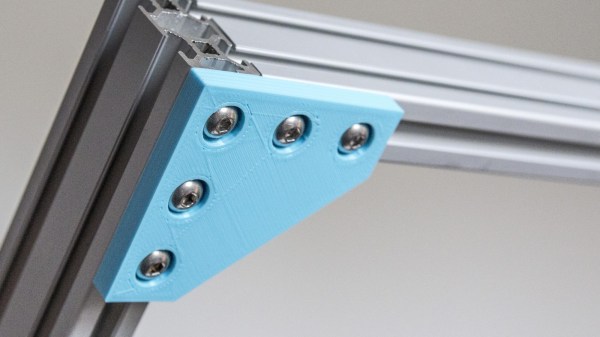
Aluminum extrusions are a boon for mechanical assemblies, but they require a stock of brackets and other hardware to be kept on hand. [mightynozzle] has decided to make things a little easier for prototyping and low-stress assemblies by creating a collection of 3D printable brackets for aluminum extrusions. 3D printing your own bracket hardware means faster prototyping, and if the assemblies don’t need the extra strength and rigidity of metal brackets you can just stick with the 3D printed versions.

The files are on Thingiverse, and include STL files of common brackets as well as an OpenSCAD script for customizing. Not familiar with OpenSCAD? No problem, we have a quick primer with examples.

This project showcases two things well. The first is that while brackets are not particularly expensive or hard to obtain, it can still be worth 3D printing them to reduce the overall amount of hardware one needs to keep on hand to make prototyping faster. The other is that 3D printing can shine when it comes to the creation of things like brackets: a few dimes’ worth of plastic can be turned into precise yet geometrically simple objects that would be a pain to make by other means. It certainly beats sitting on one’s hands waiting for parts to be delivered.

Give Workshop Pencils A Flush-Mounted Home

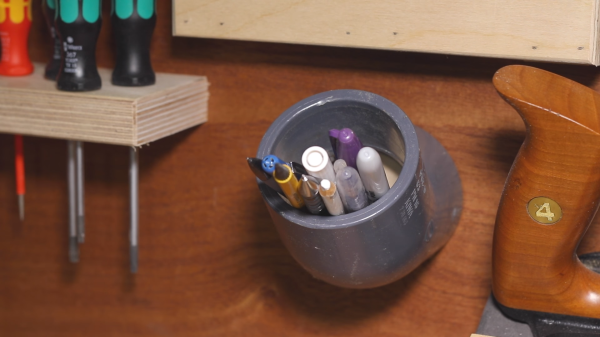
Pencils and pens are apt to go wandering in a busy workshop if they don’t have a handy storage spot. For most of us a soup can or an old coffee mug does the trick, but for a prettier and more useful holder [Stuff I Made] has a short video demonstrating a storage unit made from an elbow fitting and a scrap piece of plywood. He cuts a plywood disk that is friction-fit into one end of the elbow, then it gets screwed into a wall making an attractively flush-mounted holder in a convenient spot.

With the right joint the bottom of the holder remains accessible, as a 90 degree bend would be no good. With a shallower joint angle, a regular screwdriver can still reach the mounting screw and it’s possible to access the bottom of the holder just in case it needs cleaning or something small falls inside. You can see the process and results in the video embedded below. Not bad for one screw, a spare joint, and a scrap piece of plywood.

Continue reading “Give Workshop Pencils A Flush-Mounted Home” →

Life On Contract: How Much Do I Charge?

If you’re comfortable with the technical side of becoming a consultant or contractor but are unsure what to charge for your services, you’re not alone. “How much do I charge?” is a tough question, made even tougher by the fact that discussing money can be awkward, and at times virtually taboo.

As a result it’s not uncommon for the issue to get put off because it’s outside one’s comfort zone. Technical people in particular tend to suffer from an “if you build it, they will come” mentality; we get the technical side of things all figured out and just sort of assume that the rest — customers, money, and so forth — will fall into place afterward. If you’re lucky, it will! But it’s better to do some planning.

The short and simple answer of how much to charge is a mix of “it depends” and “whatever the market bears” but of course, that’s incredibly unhelpful all by itself. It’s time to make the whole process of getting started a bit less opaque.

A stubborn determination to solve my own problems has given me plenty of opportunity to make mistakes and commit inefficiencies over the years; I’ve ended up with a process that works for me, but I also happen to think it is fairly generally applicable. Hopefully, sharing the lessons I’ve learned will help make your own process of figuring out what to charge easier, or at least make the inevitable blunders less costly.

Continue reading “Life On Contract: How Much Do I Charge?” →

Making An Arduino Shield PCB With Fritzing

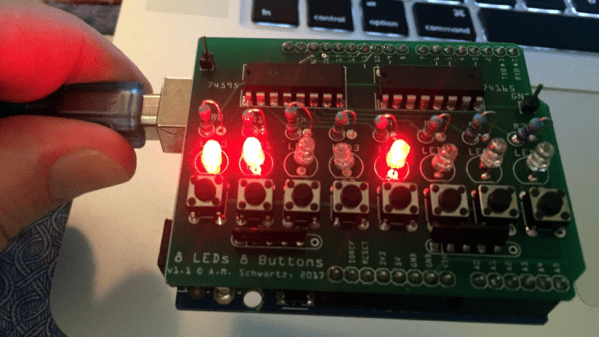
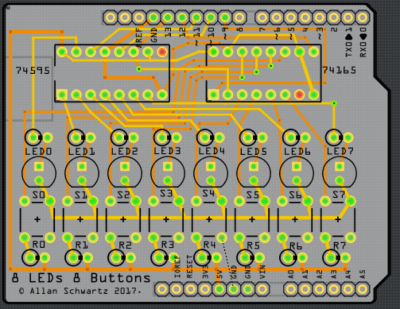
[Allan Schwartz] decided to document his experience using Fritzing to design, fabricate, and test a custom Arduino shield PCB, and his step-by-step documentation makes the workflow very clear. Anyone who is curious or has been looking for an opportunity to get started will find [Allan]’s process useful to follow. The PCB in question has two shift registers, eight LEDs, eight buttons, and fits onto an Arduino; it’s just complex enough to demonstrate useful design features and methods while remaining accessible.

[Allan] starts with a basic breadboard design, draws a schematic, prototypes the circuit, then designs the PCB and orders it online, followed by assembly and testing. [Allan] had previously taught himself to use Eagle and etched his own PCBs via the toner transfer method, but decided to use Fritzing instead this time around and found it helpful and easy to use.
About a year ago we saw Fritzing put through its paces for PCB design, and at the time found that it didn’t impress much from an engineering perspective. Regardless, as a hobbyist [Allan] found real value in using Fritzing for his project from beginning to end; he documented both the process and his observations in order to help others, and that’s wonderful.

Dumb Box? Make It Really Smart!

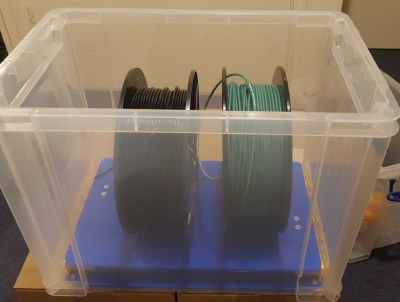
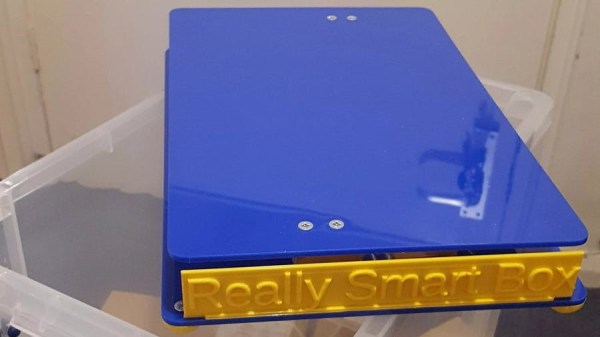
[Stephen Harrison]’s Really Smart Box is a great concept, it’s simultaneously a simple idea while at the same time being super clever. The Really Smart Box isn’t really a box; it’s a drop-in platform that can be made any size, intended to turn any dumb storage box into one that helps manage and track levels and usage of any sort of stock or consumable.

It does this by measuring the weight of the stuff piled on top of it, while also monitoring temperature and humidity. The platform communicates this information wirelessly to a back end, allowing decisions to be made about stock levels, usage, and monitoring of storage conditions. It’s clearly best applied to consumables or other stock that comes and goes. The Really Smart Box platform is battery-powered, but spends most of its time asleep to maximize battery life. The prototype uses the SigFox IoT framework for the wireless data, which we have seen before in a wireless swimming pool monitor.

This is still just a prototype and there are bugs to iron out, but it works and [Stephen] intends to set-and-forget the prototype into the Cambridge Makespace with the task of storing and monitoring 3D printer filament. A brief demo video is embedded below.

Continue reading “Dumb Box? Make It Really Smart!” →