Gorgeous 6502 Celebrates Craftsmanship Of The Early Homebrewers

The days when a computer had a front panel bristling with switches and LEDs are long gone, and on balance that’s probably for the better in terms of ease of use, raw power, and convenience. That’s not to say there aren’t those who long for the days of flipping switches to enter programs, of course, but it’s a somewhat limited market. So unless you can find an old IMSAI or Altair, chances are you’ll have to roll your own — and you could do a lot worse than this aluminum beauty of a 6502 machine.

The machine is named PERSEUS-8 by its creator, [Mitsuru Yamada]. It follows earlier machines bearing the PERSEUS badge, all of them completely homebrewed and equally gorgeous. The PERSEUS-8 would have been an impressive machine had it come along 45 years ago — the 2 MHz version of the 6502, a full 16-bit memory address space, and 16 kB of battery-backed RAM. But the mechanical and electrical construction methods and the care and craftsmanship taken are where this build really shines. The case is fabricated out of aluminum sheets and angles and looks like it could have come from a server rack. The front panel is to die for — [Mitsuru] carefully brushed the aluminum before drilling the dozens of holes needed for the toggle switches and LEDs. And the insides are equally lovely — socketed chips neatly arranged on perfboard with everything wired up using period-correct wirewrap methods. Even the labels, both on the front panel and even on the motherboard, are a joy to behold.

Builds like this are the ones that really inspire us to take the extra steps needed to make our projects not only work, but also to be beautiful. We’ve seen this kind of craftsmanship from [Mitsuru] before — recall this serial terminal that never was, or the machine that came before the PERSEUS-8.

Inside A DEC Hard Drive

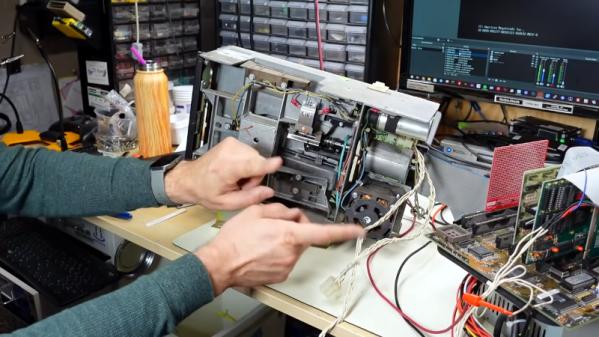
A lot of technology from the not-so-distant past doesn’t resemble modern versions very much. For a case in point, look at the DEC RS08 disk drive meant to pair with a circa 1970 PDP-8. Paired with an RF08 controller, this was state of the art, holding 262K 12-bit words with a blistering access speed of almost 63K/second unless you were plugged into 50Hz AC when it was closer to 50K/second. [Uniservo] had the disk unit, but not the controller. Someone else had a controller, but no disk drive. So [Uniservo] is shipping the disk to its new owner in a move worthy of a Reeses’ Peanutbutter Cup. The problem? The disk is super fragile and shipping is risky, so he decided to remove the platter for separate packing. Good thing for us, because we get a peek inside.

The nickel-cobalt platter looks like a thick LP record with heads underneath. As you might guess from the data transfer specification, the motor was just a common AC motor that rotated the platter against the head.

Continue reading “Inside A DEC Hard Drive”

PiStorm Brings Modern Muscle To The Amiga

The Amiga, well known as the best and greatest computer ever designed, is nonetheless a platform of yesteryear. Its 68K, and later PowerPC, architectures have both been abandoned by the mainstream, and its attractive grey industrial design no longer graces store shelves. That doesn’t mean the platform is dead however, with diehard shredders like [Claude Schwarz] working hard to keep it alive with projects like PiStorm.

PiStorm is a Motorola 68K CPU emulator, running on a Raspberry PI 3A. The Pi uses its GPIOs to interact with a CPLD chip, which acts as the logic glue to allow the modern single board computer to emulate the Amiga’s original processor. However, it’s more than just an easy way to replace or upgrade a CPU. It also offers additional features, like retargetable graphics acceleration, SCSI disk emulation, and the ability to run whatever Kickstart ROM you so desire.

While the initial work has been done on a Pi 3A, [Claude] has also demonstrated some of the basic functionality running on a Pi CM4 too. The benchmarks are more fierce than a Beyoncé Super Bowl half time show, so if you need grunt on your classic Amiga, this could be the way to go. As a bonus, files to build your own are readily available on Github, which should make it a mite more accessible than other Amiga accelerator boards.

We wonder whether this accelerator could be used to hook the Amiga up to Spotify, a la this previous build. Likely, time will tell. Video after the break.

Continue reading “PiStorm Brings Modern Muscle To The Amiga”

DIY Wireless Serial Adapter Speaks (True) RS-232

There is a gotcha lurking in wait for hackers who look at a piece of equipment, see a port labeled “Serial / RS-232”, and start to get ideas. The issue is the fact that the older the equipment, the more likely it is to be a bit old-fashioned about how it expects to speak RS-232. Vintage electronics may expect the serial data to be at bipolar voltage levels that are higher than what the typical microcontroller is used to slinging, and that was the situation [g3gg0] faced with some vintage benchtop equipment. Rather than deal with cables and wired adapters, [g3gg0] decided to design a wireless adapter with WiFi and Bluetooth on one end, and true RS-232 on the other.

The adapter features an ESP32 and is attached to a DB-9 plug, so it’s nice and small. It uses the ST3232 chip to communicate at 3 V logic levels on the microcontroller side, supports bipolar logic up to +/-13 V on the vintage hardware side, and a rudimentary web interface allows setting hardware parameters like baud rate. The nice thing about the ST3232 transceiver is that it is not only small, but can work from a 3 V supply with only four 0.1 uF capacitors needed for the internal charge pumps.

As for actually using the adapter, [g3gg0] says that the adapter’s serial port is exposed over TCP on port 23 (Telnet) which is supported by some programs and hardware. Alternately, one can connect an ESP32 to one’s computer over USB, and run firmware that bridges any serial data directly to the adapter on the other end.

Design files including schematic, bill of materials, and PCB design are shared online, and you can see a brief tour of the adapter in the video, embedded below.

Continue reading “DIY Wireless Serial Adapter Speaks (True) RS-232”

DOS Gaming PC Gets Necessary Updates

PC-104 is a standard computer form factor that most people outside of industrial settings probably haven’t seen before. It’s essentially an Intel 486 processor with lots of support for standards that have long since disappeared from most computers, but this makes it great for two things: controlling old industrial equipment and running classic DOS games on native hardware. For the latter, we turn once again to [The Rasteri] who is improving on his previous build with an even smaller DOS gaming rig, this time based on a platform even more diminutive than PC-104.

The key of a build like this is that it needs native support for the long-obsolete ISA bus to be able to interface with a SoundBlaster card, a gold standard for video games of the era. This smaller computer still has this functionality in a smaller package, but with some major improvements. First, it has a floating point unit so it can run games like Quake. It’s also much faster than the PC-104 system and uses less power. Finally, it fits in an even smaller case.

The build goes well beyond simply running software on a SoM computer. [The Rasteri] also custom built an interface board for this project, complete with all of the necessary ports and an ISA sound chip, all while keeping size down to a minimum. The new build also lets him give the build a better name than the old one (although he phrases this upgrade slightly differently), and will also let him expand some features in the future as well. Be sure to check out that first build if you’re new to this saga, too.

Continue reading “DOS Gaming PC Gets Necessary Updates”

A Faux BBS Gets Software On To Your Vintage Machines

Back in the golden age of modems and phone lines, bulletin board systems, or BBSes, were a great way to find new software from the comfort of your own home. Most have shut down over the past few decades, as the Internet took over as a more flexible method of cat picture software distribution. [equant] was a fan of browsing for warez through a text interface however, so recreated the experience in a way that’s useful today. The result is RetroBridgeBBS.

The software runs on a modern PC, ideally a Linux one that runs Python 3 and has a serial port. Then, you can hook up your old retro computers via serial using a null modem cable. Fire up appropriate terminal software on the retro computer and you’re rewarded with a BBS-like interface. From here, you can search selected online repositories for software, and download what you like. The host PC parses requests from the retro PC over the serial link, and shuffles back the requested files downloaded from the Internet. Currently it’s set up primarily for Macintosh users, with some useful features to avoid downloading StuffIt archives of the wrong version – a perennial frustration in the 90s. Future plans involve expanding the system to suit more platforms.

It’s technically anachronistic, but it feels like a period-correct way to get software onto a vintage computer. It’s also a great way to do so when you’re lacking appropriate floppy hardware, hard disk emulators, or network cards – all of which can be expensive and in short supply. There’s other ways to go about it, too, of course – you can do some nifty things with an ESP8266, don’t you know! Video after the break.
Continue reading “A Faux BBS Gets Software On To Your Vintage Machines”

Logic Chip Teardown From Early 1990s IBM ES/9000 Mainframe

The 1980s and early 1990s were a bit of an odd time for semiconductor technology, with the various transistor technologies that had been used over the decades slowly making way for CMOS technology. The 1991-vintage IBM ES/9000 mainframe was one of the last systems to be built around bipolar transistor technology, with [Ken Shirriff] tearing into one of the processor modules (TCM) that made up one of these mainframes.

A Thermal Conduction Module from an IBM ES/9000 mainframe.

Five of these Thermal Conduction Modules (127.5 mm a side) made up the processor in these old mainframes. Most of note are the use of the aforementioned bipolar transistors and the use of DCS-based (differential current switch) logic. With the already power-hungry bipolar transistors driven to their limit in the ES/9000, and the use of rather massive DCS gates, each TCM was not only fed many amperes of electricity, but also capable of dissipating up to 600 Watts of power.

Each TCM didn’t contain a single large die of bipolar transistors either, but instead many smaller dies were bonded on a specially prepared ceramic layer in which the wiring was added through a very precise process. While an absolute marvel of engineering, the ES/9000 was essentially a flop, and by 1997 IBM too would move fully to CMOS transistor technology.

Over the years we’ve featured a lot of [Ken]’s work, perhaps you’d like to know more about his techniques.